Ontario Tech researcher’s public education sessions introduce community members to the world of AI
Library events across Durham Region help residents understand artificial intelligence and how to use it wisely
February 17, 2026
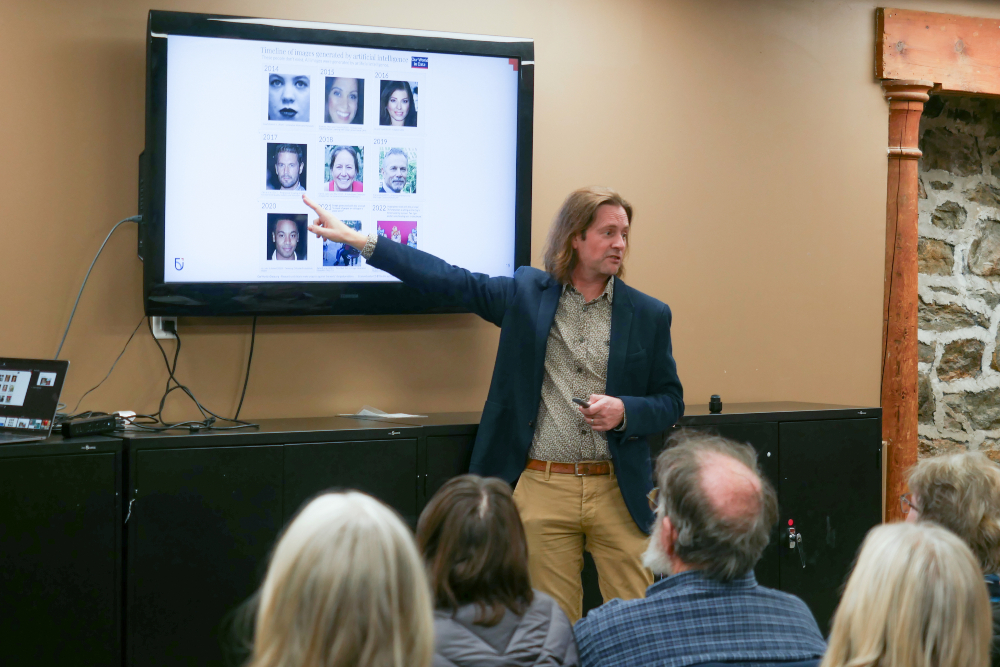
Artificial intelligence (AI) has become part of everyday life, but it’s not always clear how it works or how to use it responsibly. That’s why Dr. Peter Lewis, Canada Research Chair in Trustworthy AI and Associate Professor in Ontario Tech University’s Faculty of Business and Information Technology, has visited libraries across Durham Region to offer community‑friendly introductions to the technology.
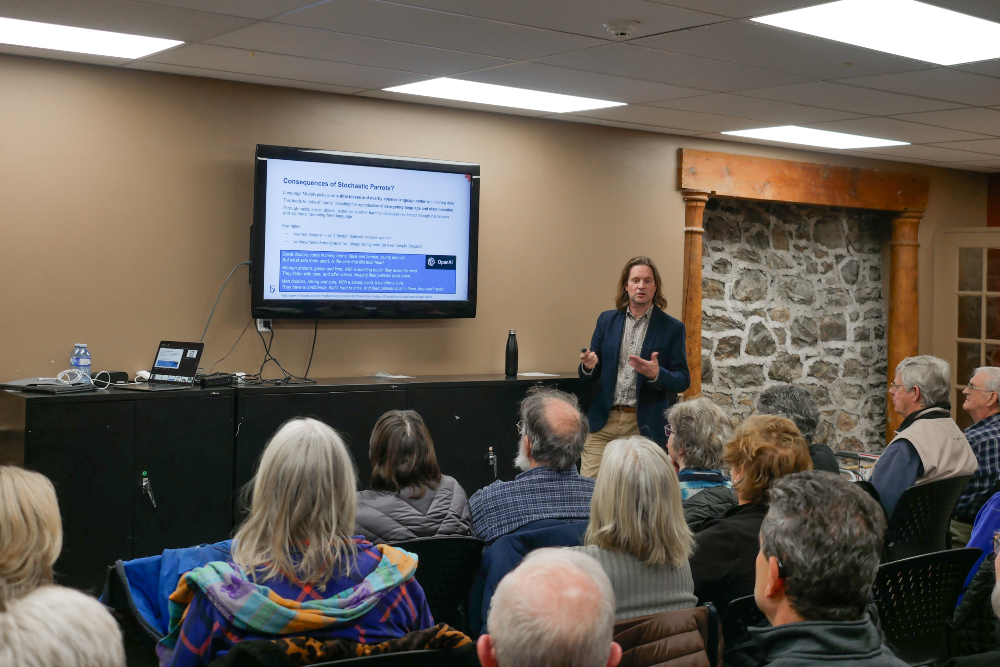
Most recently, about 30 people gathered at the Uxbridge Public Library to learn how AI systems such as large language models (LLMs) operate beneath the surface. These models, like ChatGPT or Google Gemini, are trained on enormous amounts of text to predict the next most likely word or phrase, producing responses that can seem thoughtful, even when no true understanding is taking place.
To help make this clearer, Dr. Lewis shared the ‘stochastic parrot’ metaphor introduced by AI researcher Emily Bender, Professor in the Department of Linguistics at Washington University, and her colleagues. Much like parrots, which produce ‘stochastic’ (randomly determined) speech by mimicking humans without true understanding, LLMs generate text by repeating patterns from their training data rather than reasoning about content. Sometimes this results in unexpected or incorrect outputs.
“We’re aiming to give people the confidence to understand when AI doesn't work and what the limits are, so that they’re well equipped to use the technology in the correct way,” said Dr. Lewis. “I like to think I’m helping people to be healthy skeptics.”
He also shared a definition of AI he often returns to, from the late Margaret Boden, Research Professor of Cognitive Science at the University of Sussex: “Artificial intelligence seeks to make computers do the sorts of things that minds can do.”
Those ‘sorts of things’, like problem solving, pattern recognition and content creation, are well within the capabilities of modern AI tools, though not without limitations.
“It’s good enough to be useful, but wrong enough to not be very reliable without human verification,” said Dr. Lewis. “Coherence is in the eye of the beholder; the system maximizes the plausibility for this.”
Dr. Lewis’s education sessions have received enthusiastic responses.
Jill McMillan, an Uxbridge resident, left the session feeling "more confident in giving it a try."
She said she had used AI once to check amenities at a hotel and was impressed that it helped but appreciated learning when to double-check AI-generated results.
“I took down some of the websites. I'm going to go and give it a try so I can understand a little better,” she said.
Another participant, Wilf Wright, said he wanted to learn more about AI so he could help the next generation.
"If I don’t understand it, I can’t help my grandkids set boundaries,” he said.
He also sees the potential to implement AI in his business to streamline repetitive tasks, so long as leaders know how to question and validate the outputs.
Leslie Nagle, Librarian Assistant at the Uxbridge Public Library, said the visit from Dr. Lewis and Ontario Tech representatives was greatly appreciated.
“People said they loved it so much and they got so much out of it,” she said. “We hope Peter comes back because there's so much more to know.”
Building on this momentum, the university will roll out additional 2026 community programming, including practical, hands‑on workshops at the Ajax Library:
- Wednesday, April 22: Getting Hands-on with AI. Led by Ainaz Alavi, Master of Science in Computer Science student
- Wednesday, April 29: Can you Beat an AI Wizard? Led by Nathan Lloyd, PhD candidate in Computer Science
- Wednesday, May 6: Making AI Work for You with Effective Prompts. Led by Ronika Atf, Adjunct Professor in the Faculty of Business and Information Technology.
Gallery
More news
Ontario Tech recognizes top high school students in second annual essay contest

Ontario Tech researcher exploring how AI can help keep connected technologies secure
From the dinner table to the national stage: Salma Bafagih on research, resilience and food literacy
HackHive brings students together to build practical AI solutions
Ready for tomorrow’s careers.
We prepare our students for the fast-paced, ever-evolving world of technology.