HackHive brings students together to build practical AI solutions
Durham Region’s largest hackathon welcomes more than 250 students to Ontario Tech to design projects with real-world impact
February 20, 2026
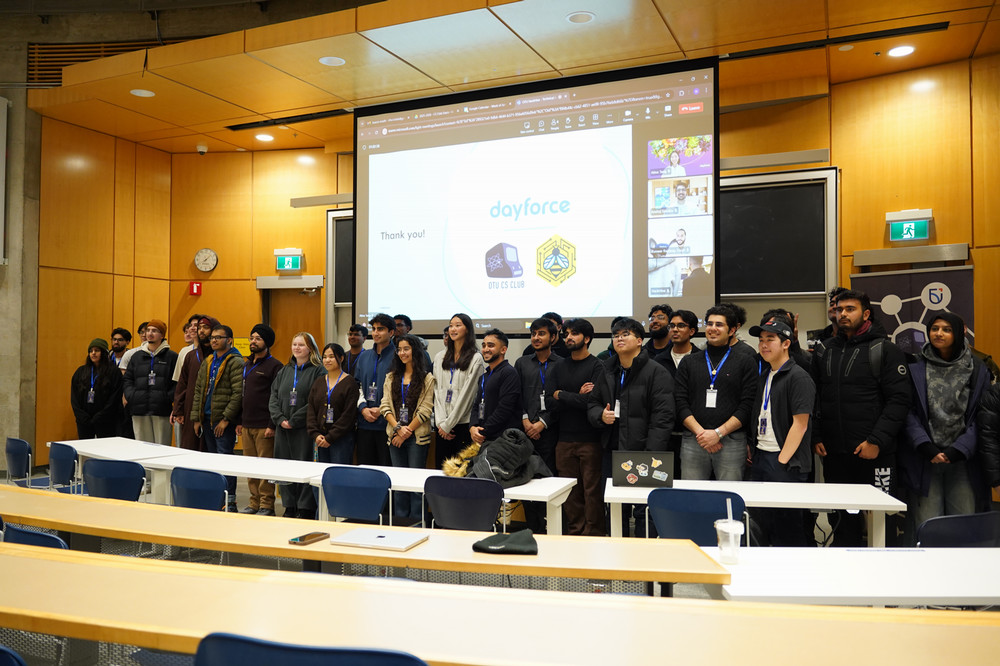
Growing employer expectations for AI fluency means graduates must be comfortable working alongside artificial intelligence (AI) tools, making it essential for students to have opportunities to learn how to apply AI responsibly to real-world challenges.
HackHive, Durham Region’s largest hackathon event, created space for that kind of learning, welcoming more than 250 post-secondary students to Ontario Tech University for an intensive weekend of practical, human-centred AI development. Organized by the Ontario Tech Computer Science Club, the event saw a record-breaking applicant surge of more than 550 applicants from more than 24 schools and across three different countries. HackHive challenged participants to collaborate, experiment and turn their ideas into action, while successfully transitioning to a virtual format due to weather conditions.
“HackHive showcased what’s possible when talented students come together with purpose and ambition," says Jun Bin Cheng, fourth-year Software Engineering student and Hackathon Specialist. "The quality of the AI projects, the level of collaboration and the energy throughout the weekend reflect the strength and innovation of our student community.”
AI built for real-world use
Working in teams, students developed more than 50 AI-powered projects designed to address real-world challenges and competed for $6,000 in prizes.
First place – Ontario Tech Software Engineering students:
- Ali Hakkani
- Krishna Mallick
Their winning project, NeuroDetect, is an AI-powered assistant that helps radiologists analyze brain MRA scans faster.
Several projects explored AI for social good, aligning with Ontario Tech’s commitment to tech with a conscience: using technology to improve lives and communities. One standout solution—TurleTalk—introduced an AI-powered platform to help Indigenous communities preserve endangered languages through interactive lessons, conversational practice, pronunciation feedback, storytelling tools and offline access for communities with limited internet connectivity.
Other notable projects:
- CutOS: AI-powered copilot for video editors that allows creators to describe what they want done, such as adding transitions, cropping clips, or applying green-screen effects, while the system edits the video automatically.
- Brailliant: Hands-on learning device to help users learn Braille through tactile interaction.
- Rosetta: A real-time lecture assistant that translates speech, adds source-linked transcripts and generates structured notes to help ESL and international students learn without language barriers.
Learning, connection and career development
Beyond project development, HackHive offered programming designed to support learning, connection and career growth. Students participated in technical and career-focused workshops, a women-in-tech networking meetup and a mini pitch competition, building their professional communication and collaboration skills.
First place – Mini pitch competition (Ontario Tech students)
- Jedidiah Dennis (Computer Science)
- Manasvi Naik (Networking and IT Security)
Their winning pitch explored the implications of relying on AI weather-prediction algorithms over human prediction.
Powered by industry support
HackHive was sponsored by technology companies including Microsoft and Kyndryl, in partnership with Major League Hacking (MLH), a global organization that supports student-run hackathons. In addition, industry mentors, judges and collaborators from across the technology, education and startup sectors played a key role in guiding participants and strengthening the overall experience.
This year, HackHive reached a major milestone by becoming an official MLH affiliate.
More news

Ready for tomorrow’s careers.
We prepare our students for the fast-paced, ever-evolving world of technology.