Ontario Tech launches human-centred AI Learning Agent pilot
Human-centred design and academic integrity built into AI-supported learning
February 19, 2026
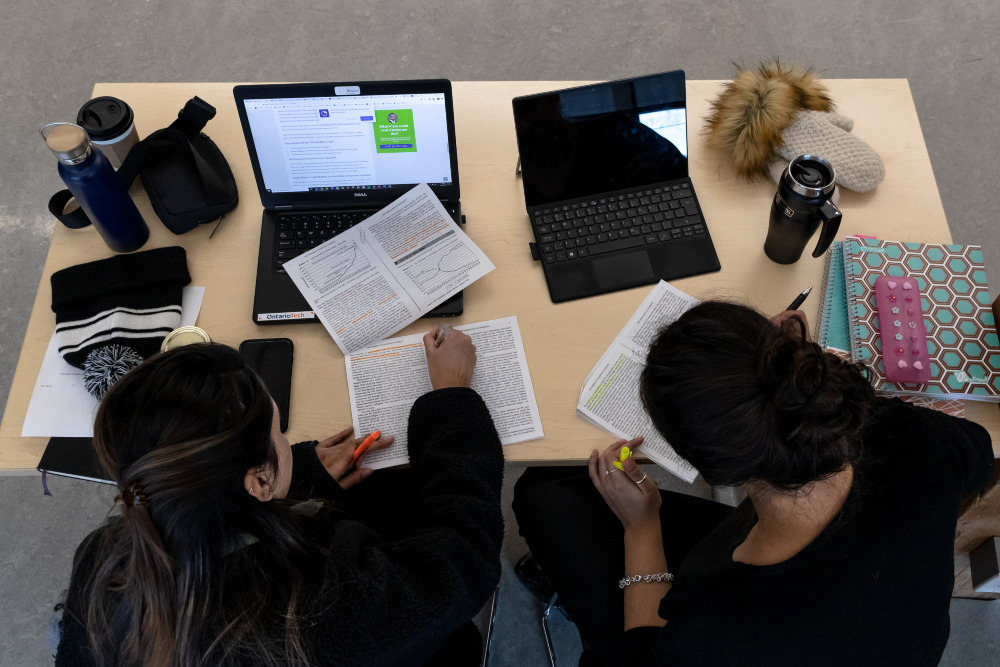
As conversations about artificial intelligence (AI) accelerate across higher education and the workplace, Ontario Tech University is focused on a more fundamental question: how do we prepare students to work with technologies that must be trusted, governed and accountable to people?
Through a new pilot program running during the Winter and Spring 2026 terms, students in 22 undergraduate and graduate courses across all Faculties are participating in early testing of an AI Learning Agent: an in-house course-based AI learning system designed around trust, accountability and academic integrity. Instead of simply adopting off-the-shelf AI solutions, the university is turning everyday learning into a real-world environment, and testing how technology should support judgment, integrity and human decision-making.
“Canada’s AI sector is a key job creator and driver of productivity, innovation, GDP and economic growth, and universities have a responsibility to teach students how to develop and use AI systems to serve humanity,” says Dr. Steven Murphy, President and Vice-Chancellor, Ontario Tech University. “As a university that champions technology, it is critical that we take a leadership role by developing solutions that prepare our future workforce to design and use AI responsibly.”
Students shaping how AI should work
What sets this initiative apart is how the technology is designed and governed. Ontario Tech students actively test the tool and provide feedback that informs system refinements, governance decisions and future rollout considerations. In doing so, they gain firsthand insight into how AI systems are shaped through constraints, oversight and ethical decision-making, reinforcing principled decision-making and academic integrity with innovation.
AI adoption in higher education is no longer a future trend; it’s already widespread. Recent industry data shows that around 86 to 90 per cent of post-secondary students report using AI tools in their academic work, underscoring AI’s influence on learning and the need for thoughtful, institution-led integration.
“This isn’t about adopting the latest tool,” said Manny Kandola, Chief Technology Officer, Ontario Tech University. “It’s about teaching students how technology should be designed, tested and governed. By involving them directly, we’re preparing graduates to work responsibly with AI in careers that don’t yet exist, while building digital trust from the start.”
Developed to support learning, not replace it
Unlike public AI tools, the Learning Agent draws only from instructor-approved course materials and is designed to guide reasoning rather than generate answers. For example, instead of producing a solution, the system prompts students with guiding questions aligned to course learning outcomes, reinforcing critical thinking. Available beyond classroom hours, the tool complements teaching while preserving the central role of faculty-led discussion and hands-on engagement.
By piloting the system in live courses, faculty gain real-time insight into recurring student questions and learning challenges. This visibility supports more targeted teaching, timely adjustments to lectures and tutorials and continuous course improvement while maintaining full instructor control over system access and content. This turns everyday learning into a real-world testbed for responsible AI design.
Built with privacy, integrity and trust by design
Privacy, academic integrity and data protection are embedded in the AI Learning Agent by design. The tool operates entirely within Ontario Tech’s secure digital environment and draws only on instructor-approved course materials. Student interactions are not used to train external AI models, and faculty retain full control over system access and use.
Built-in safeguards help reduce bias, prevent misuse and ensure human oversight remains central. The result is a learning tool that supports exploration and inquiry without compromising academic standards.
Additional resources
More news
Ontario Tech recognizes top high school students in second annual essay contest

Ontario Tech researcher exploring how AI can help keep connected technologies secure
From the dinner table to the national stage: Salma Bafagih on research, resilience and food literacy
HackHive brings students together to build practical AI solutions
Ready for tomorrow’s careers.
We prepare our students for the fast-paced, ever-evolving world of technology.